"Elliot", owned by Ron and Hazel Bunch, along with "Jake"
owned by Sandra and Gary Shaffer, both have a condition called
degenerative myelopathy. Their owners contacted the foundation about their dogs' conditions. A little research and a little networking
on the foundation's part soon revealed research describing a mutation discovered to be associated in 5 dog breeds (the Pembroke
Welsh corgi, Boxer, Rhodesian ridgeback, and Chesapeake Bay retriever; Awano et. al.,
PNAS, vol.
106
(8), pgs 2794-2799) The researchers behind the work were also willing to look at the DNA from both dogs to see if the
mutation was in the Airedale cases as well.
Dr. Gary Johnson at the University of Missouri soon
had the samples in hand and in less than 2 weeks, a result has been obtained. Both Elliot's and Jake's DNA tested positive
for the mutation.
The expression of DM is variable - often presenting symptoms in the dog after
8 years of age. Researchers call this age-related penetrance. Other factors involved in the expression of clinical
signs of the disease are currently being studied, including in the Airedale samples!, to further pinpoint disease expression.
This disease in canines is also a good model study for the human disease,
amyotrophic lateral sclerosis, aka ALS or Lou Gehrig's Disease.
Now, with this testing and confirmation that the mutation
is the same in the Airedale DM, Airedale breeders who survey their owners and find cases of DM appearing can test future sires
and dams for breeding consideration.
Elliot's Story (written
by owner Ron Bunch, 2011)
Elliot before paralysis:
Elliot with his cart:
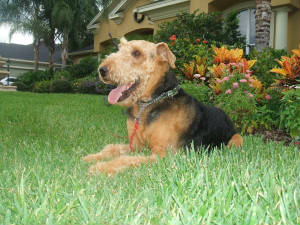
 Four years ago, Elliott came into our lives via the rescue route. A big
handsome boy at 7 1/2 years old, 25"tall, and weighing about 75 lbs. Full of energy and ever ready to chase
down an elusive gecko with a vengeance, go for a quick swim in the pool, or to play one of his other favorite games
of tramping off with one of his bones, pursuing an ideal place to dig a hole in the yard and hide the bone, then
covering it back up by pushing back all the dirt using only his snout to do so. At which point he would look all around
to see if any of the other dogs were lurking close by to retrieve his prize possession. If so, he would just lie down
and protect his investment until all had given up on their quest to retrieve his bone. For the first two years
we had Elliot, he was everything an Airedale was proposed to be. Quarky, comedic, stubborn, and loveable. Full of
life and awesome in every way.
Four years ago, Elliott came into our lives via the rescue route. A big
handsome boy at 7 1/2 years old, 25"tall, and weighing about 75 lbs. Full of energy and ever ready to chase
down an elusive gecko with a vengeance, go for a quick swim in the pool, or to play one of his other favorite games
of tramping off with one of his bones, pursuing an ideal place to dig a hole in the yard and hide the bone, then
covering it back up by pushing back all the dirt using only his snout to do so. At which point he would look all around
to see if any of the other dogs were lurking close by to retrieve his prize possession. If so, he would just lie down
and protect his investment until all had given up on their quest to retrieve his bone. For the first two years
we had Elliot, he was everything an Airedale was proposed to be. Quarky, comedic, stubborn, and loveable. Full of
life and awesome in every way.
In September of 2009, we noticed that Elliot was showing a slight
weakness in his back quarters. We took him to the vet and had some x-rays taken to determine if he was developing some
form of arthritis or even perhaps a potential problem with hip dysplasia. The x-rays were inconclusive and the vet prescribed
low dose of Rimadyl and asked us to continue watching him. Two months later, we took him back to the vet because his
gait was seemingly getting worse. Upon examination, the vet noticed Elliot's back right foot was turning inward as he
walked and his nails had uneven wear. The next thing the vet said was that it was in his opinion that Elliot was in early
stages of DM or Degenerative Myelopathy. He went on to explain it is a disease that atrophies the spinal column and connecting
nerve endings and tissues in either one or both hind quarters and eventually moves forward essentially paralyzing the
dog. In human terms, it is almost the same as Muscular Sclerosis. It typically takes about one to three years to complete
the process and is irreversible. The good news is it is pain free. The bad news is it requires constant care as it progresses.
When Elliot first came down with this disease I went to the internet and tried to
search out as much information as possible. I came across two sites that seemed to sum up much better than I just how
insidious this disease is. The first is at "About.com", then once on the site, search canine Degenerative Myelopathy,
then scroll down and click on "The Viewer Viewpoint--- The Stages of Degenerative Myelopathy". The second is "LaPawSpa.com."
Once on the site, search "The DM Diagnosis." Each article is easy reading, short, and to the point. Airedales
are not one of the primary breed line carriers, but I know of at two other cases within our own ranks in Florida. These
articles are very informative and indicate just how difficult it is to diagnose and that most of the time it is mis-diagnosed.
Obviously after almost two years fighting this disease, we are in the final stages. Everything
that is suggested in these articles we have utilized and/or are continuing to use. Water therapy, massage, exercise,
medications, supple,ments, special diet, slings, booties, diapers, and even a custom made wheel chair. All of these have
helped in slowing down the progression and yet it continues to take its toll.
Insidious as this
disease is, Elliot is pain free and continues to adapt to his limitations. The front half of Elliot is still very alert
and as mentally sharp as ever. He loves meal time and never misses an opportunity to get his share of midday snacks.
He loves to lay in the cool grass in the mornings and early evenings and just the mention of taking a WALK brings him
to attention and ready to get hooked up to his set of wheels. Once ready he knows exactly the route and leads the way.
(Side Note: He can be seen on You Tube by clicking on "ElliotsNewWheels"). All in all, Elliot is still a courageous
happy dog full of life and a very large part of our family.